Sunday, August 23, 2009

Volkswagen death spiral, again

After twenty years of sales decline, primarily caused by the appalling quality of their cars and dealers, Volkswagen has determined that it will cement its doom by making its products "more American."
The Jetta platform will provide the basis for VW’s new workhorse for the American market, and the company is “pretty much convinced” that Jetta will be the name as well, Mr. Jacoby said. But he promised a retooling that would try to blend European design and allure with Americans’ practical needs.

For instance, there will be more and different types of cup holders — a must-have for American consumers.

A different suspension will yield a smoother ride. Folding mirrors, a necessity in tight European streets, will not be standard. The acceleration and braking pedals will be farther apart in response to American complaints that it is easy to accidentally press both simultaneously.

And some other device will replace the balky dials used to recline seats in European cars. Market research in the United States found that “women break their fingernails or scratch their hands,” Mr. Jacoby said.

Of course we've been here before, when VW turned its excellent Mk I Golf into the americanized Rabbit, complete with vinyl woodgrain accents on the dashboard and Buick-esque hub caps:

VW seems unable to remember why it was successful in the US in the first place: Inexpensive, carefully engineered cars that were reliable, cheap to operate, and easy to maintain and repair. Now VWs are expensive, unreliable, and ferociously expensive to maintain (try changing a burnt out headlight without a dealer visit). Naturally making them bigger, heavier, and softening up the suspension will do the trick.

Sheesh.

Thursday, April 30, 2009

Morning Hike

These beautiful days, I'm trying to get out for a walk in the morning before work. Last week, I had a great view of the Boston skyline at sunrise:

Optimizing Safari 4

So I love the Apple Safari 4 beta -- it is screamingly fast and it runs nicely on a PPC Mac (unlike Chrome, which only runs on Intel).

One big drawback, when compared with Firefox, is that targeted links cannot be forced to open in a new tab instead of a new window (the preference setting has no effect).

Turns out that there is a way to make this work: Open a Terminal window and type

defaults write com.apple.Safari TargetedClicksCreateTabs -bool true

And restart Safari. That's it.

(Now, if only Safari 4 supported blogger's wysiwyg editing features.)

Tuesday, April 07, 2009

Peepers

They're all done for the season, but a week ago they were out in force:

Wednesday, April 01, 2009

Living the high life...

... in my El Camino Super Sport.


Tuesday, March 03, 2009

Some Great Clothes Sources

If you're 2 metres tall (or more), finding shoes and clothing is tough! Here a couple of sources you might try:

For hipster doofus styles (think Chuck, or Kramer), go to oddball.com.

Basic blue jeans at a basic price? Try Carhartt jeans from dungarees.net.

Columbia has a great line of big and tall shirts and outerwear (with long, long sleeves!). Good prices from supercasuals.com.

And these links are untainted by any commerce -- they're just places that I like!

Places I don't like? Casual Male XL, with poor quality, limited sizes, and wildly inflated prices. Like $60 for a pair of ill-fitting Levis jeans.

Monday, August 06, 2007

Antidiscrimination law

Yesterday's Boston Globe reports on a law before the Massachusetts legislature that would outlaw emploment (and some other) forms of discrimination based on a person's height and weight.

I say bravo!

"How's the weather up there?" A hate crime, I say.

Tuesday, December 05, 2006

"If you're going the minivan route, you wind up with the Odyssey"

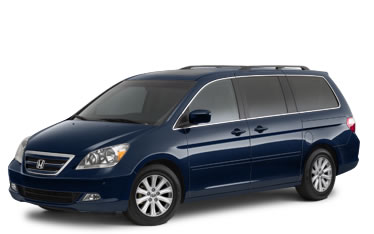
That's what our friend Maureen says anyway. It turned out that way for us, as we just traded in the grey BMW wagon for a 2007 Odyssey:

Here's how we got there.
Step 1: Enough legroom for tub (who is 6'9" tall):
  • Caravan SXT -- excellent
  • Pontiac SV6/Saturn Relay/Chevy Uplander/Buick Terraza -- excellent
  • Honda Odyssey -- adequate
  • Hyundai Entourage/Kia Sedona -- barely adequate
  • Toyota Sienna -- hopelessly inadequate
Not evaluated: Ford Windstar, Dodge Sprinter

Step 2: Basic driving dynamics?
  • Caravan: Marginal handling, with vague sloppy steering. Excellent throttle response and very crisp shifting from a 4-speed manual transmission. Lots of road noise.
  • GM: Terrible handling with excessive body roll. Poor throttle response, sluggish 4-speed transmission, and marginal overall power.
  • Hyundai/Kia: Adequate handling and throttle response, reasonably quiet. Smooth-shifting 5-speed transmission.
  • Honda: Smooth handling, shifting. Adequate power. OK ride. Not particularly quiet.
Step 3: Research
  • Caravan: Poor reliability, poor resale value. Excellent incentives ($4000 cash rebate) and reasonable base price. Mediocre mileage (18/25)
  • Honda: Average reliability. Good gas mileage (20/28) with EX-L and Limited trim. No incentives and relatively high base price. No options.
  • GM: Named by Forbes magazine as one of the 10 worst cars you can buy in America due to abysmal reliability scores.
  • Hyundai/Kia: Unknown reliability (new model). Anecdotes from edmunds.com not promising. Mediocre mileage (18/25) with anecdotal reports of much poorer mileage.
Step 4: Extended test drive
  • Caravan: Rented a white 2007 SXT from Enterprise for a weekend trip to New Hampshire. Versatility of stow-and-go seating was excellent. Tons and tons of room for people and stuff. Very relaxed driving experience. Very secure during a torrential rainstorm (kept up 65-70 MPH under abysmal conditions without trouble). Controls were extremely simple to use. Front seats offered zero lower back support, with squishy cushions and revolting fabric colors. Dashboard and interior materials cheap in the extreme. Somewhat bouncy ride, and not especially quiet. Wife declares "no way" because of the uncomfortable seats.
  • Honda: Borrowed a 2007 EX from Bernardi Honda for the day. Very pleasant, car-like driving experience with good visibility. Controls somewhat complex. Seats comfortable. Reasonably quiet. No problems.
Step 5: Model selection
  • LX: Manual front seat doesn't offer as much legroom as power seat in EX and above, so scratch this.
  • EX: Cloth seats only. Not good for 3 year-old who requires continuous feeding.
  • EX-L: About $2500 more. Leather seats plus variable-cylinder control motor for better mileage, and sunroof.
  • Touring: Another $2500 gets you fog lights, lazy susan underfloor storage, power liftgate, and run-flat tires with an oddball wheel size.
So, EX-L it is.

A few testing highlights:

Best Feature:
Dodge Caravan power doors: Switches work easily but you can always open and close the door manually (it has a simple clutch mechanism). Contrast this with the Honda, where you must disable the power doors to use them manually.
Biggest Surprise:
The Hyundai looks great on paper, and it's gotten great reviews from media as diverse as Consumer Reports and the New York Times, but it is as unrefined and crude as a pickup truck (and that includes the dealership experience).
Where Honda is Behind:
A separate key fob for the remote controls. Even the Dodge has the buttons integrated into the head of the key.

Monday, November 20, 2006

The best Porsche 911


Well my 1988 non-sunroof coupe, naturally, but why?
  • It has a galvanized body shell, which means that, in general, rust isn't a problem. Porsche started galvanizing with the 1975 model year. Some would say that this makes 1974 the absolutely worst year, since it has the heavier bumpers without the compensation of a rust-free body.
  • It has a 3.2 litre engine, which is the largest possible displacement using the original case (given the size of the case and the spacing of the bore centers). The 3.6 litre engine introduced with the 1989/90 C2/C4 964 cars uses funky offset head studs to achieve its displacement (which in turn led to the oil leak problems on the early cars).
  • It has simple digital engine controls, which means no points to adjust or replace, and long-life spark plugs. Throttle response is excellent with a single oxygen sensor, and the power is good (217 BHP) if not spectacular. It is very nearly completely user-serviceable, with the only microprocessor in the car being contained within the DME brain. All the mechanical bits are essentially the same as a pre-electronics car.
  • It has no ABS. The 964 introduce ABS to the Porsche 911, but ABS requires close to zero-offset steering. This meant that the Fuchs wheels wouldn't fit. The zero-offset geometry also meant that the cars needed power steering. Which made them heavier. Which led to the development of the 3.6 motor. See above.
  • It has torsion bar suspension. This means a nice roomy trunk in the front (unlike later cars).
  • It, along with other 87-89 cars, has the best legroom of any Porsche 911 ever made. The G50 shift linkage puts the shift lever further from the steering wheel than in earlier (915) cars, while the seat track is mounted lower and further back than in both pre-1986 and post-1989 cars. The 86-89 cars include small recesses in the central tunnel to allow the seats more travel, while the post-89 cars have airbags, which cause the designers to limit seat travel so as to guarantee good performance for unbelted drivers.
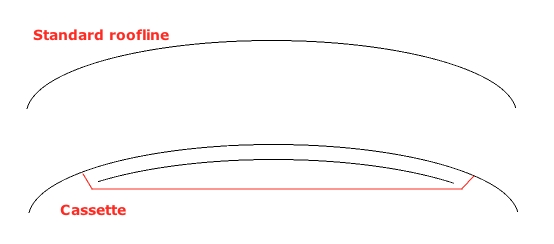
  • It has no sunroof. This means an extra 3" of headroom, plus about 30 pounds less weight up in the roof of the car. Three inches? Really? Yes, because of the shape of the 911 roof, the movable panel in the sunroof has to drop significantly in its rearward travel. The sunroof mechanism includes a steel box into which the panel travels, and this box forms a chord across the otherwise highly arched roof:
  • It has no air conditioning. The pre-1990 Porsche 911 AC system is a Rube Goldberg monstrosity that includes a huge compressor hung out over the tail of he car, one condenser mounted on the engine cover (where it thoughtfully pre-heats the intake and cooling air charge and where the constant hose flexing leads to leaks) and a second condenser mounted underneath the front bumper, so perfectly hidden from airflow that a blower is required to draw air from behind the front bumper and blow it down through the condenser). The evaporator is mounted in front of the footwell, and it only operates in recirculating mode, drawing air from the footwell, cooling it, and blowing it out the dash vents (which means that no fresh air comes out the dash vents). These components are strung together with about 20 feet of AC hose. Without this system in place, and with the dash vents replumbed to blow fresh air, the car is about 70 pounds lighter and frankly more comfortable to drive.
So in summary, this 911 - which is really one of a kind -- is about the best there is. It has the classic looks (except for the modern bumpers, which are only available if you accept the rust problem, plus less legroom), it is only about 150 pounds heavier (bumpers, sound deadening, a couple of extra heater blowers) than the lightest of the early cars), and it has the highest power rating of any user-serviceable 911 (to get more, you either need devilishly complex MFI or soul-sucking modern engine management).

Friday, November 10, 2006

212

Not the boiling point of water (in Fahrenheit), but how much I weighed this morning. Maybe not a weight that would make most people happy, but if you're 6'9", then 212 is a nice weight.

I decided to try to lose some weight last spring in the hopes that it might reduce the pain associated with my bad back. I dropped about 35 pounds, basically by just eating less (I was, and still am, exercising regularly). It was surprisingly easy, and being thinner has really improved my happiness level:
  • I have more energy
  • Less back and hip pain
  • Clothes fit better
  • Look better
  • Cars fit more comfortably
So yay.

Sunday, October 22, 2006

Air

As the seasons change, and temperatures start to fall, the air pressure in a car's tires begins to fall. Typically, about 1 PSI per 5 degrees Fahrenheit. Finding a gas station that has a working, free supply of compressed air can turn what should be a five minute chore into a 30 minute hassle.

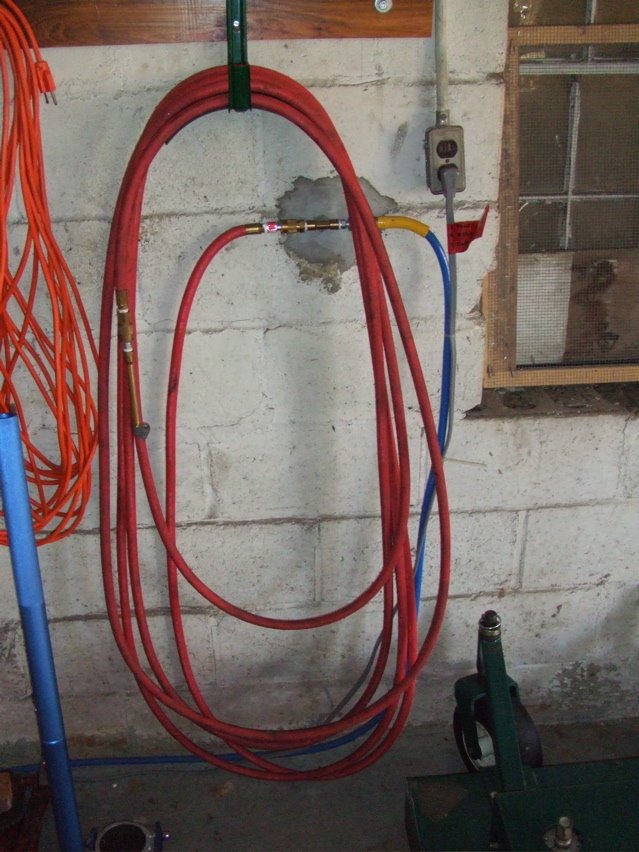
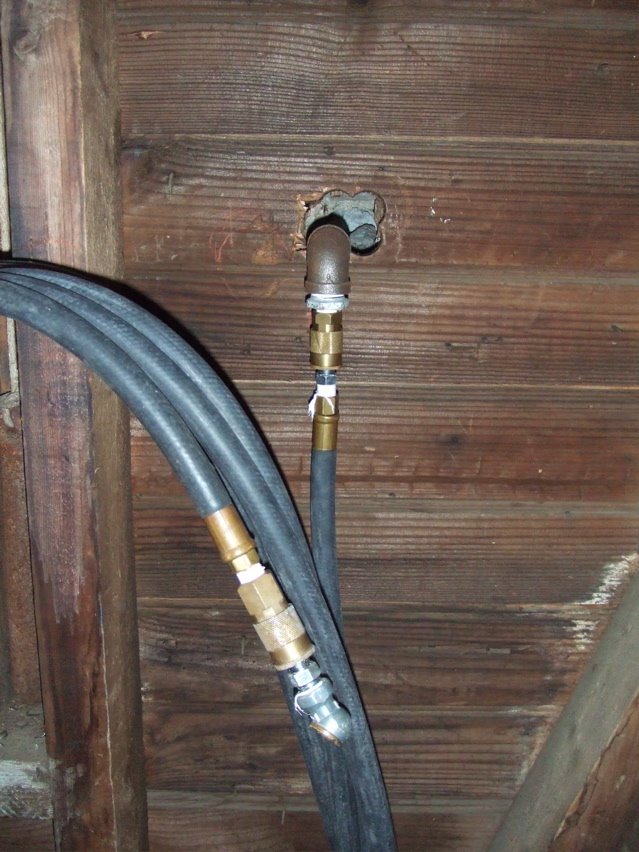
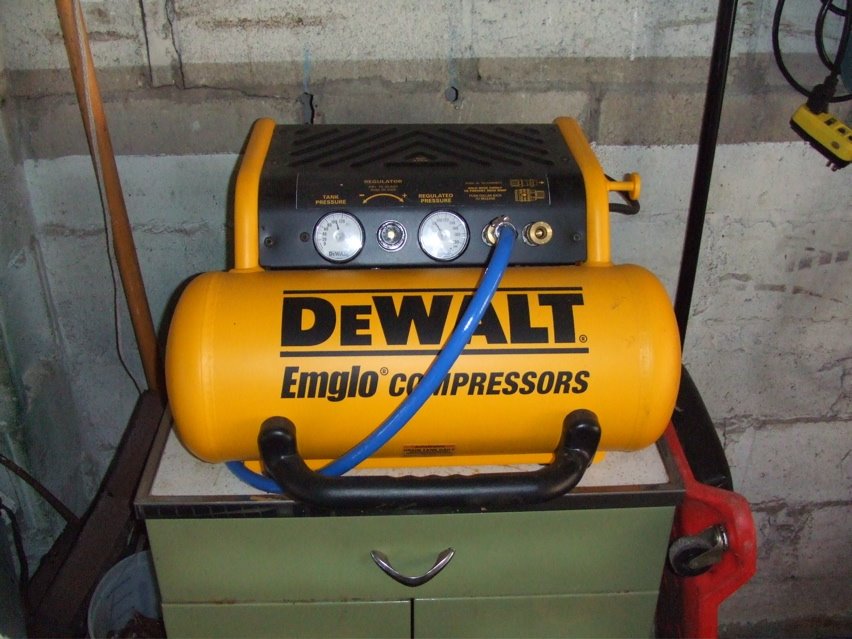
Our house has a bifurcated garage -- a small wood-framed two-car garage next to a big cinderblock structure -- and a couple of years ago, I decided to install a source of compressed air. I have a small contractor's compressor which is plumbed into a pair of hoses, one in each garage:


The compressor is a small, oil-lubed compressor intended for nailguns. I use it to pump up tires and run an impact wrench. It will run any kind of an air tool except for a drill, air-chisel, or cut0ff tool.


What I like about it (as opposed to a "normal" large-capacity shop compressor) is that it does every automotive chore for which compressed air is required (blowing out fuel lines, running an impact wrench, and blowing pistons out of brake calipers). The things that it doesn't do, can be done using electric tools. Because it is small, it builds pressure quickly (like 20 seconds from empty), so when it's time to pump up the tires, you're up and running quickly. With a big shop compressor, you have to waste the time and energy of pumping up the whole tank before you can do anything.

Tall bike: nearly complete

I'm working my way through the componentry on the tall bike, replacing and upgrading things that are worn out or obsolete. I was unable to get the existing cup-and-cone headset to adjust properly, probably because it was missing a spacer, so I decided to splurge and have Harris Cyclery in Newton install a new Chris King headset. So at this point, the key "big bearings" on the bike (headset and bottom bracket) are now high-end sealed units (Phil Wood BB and Chris King headset).

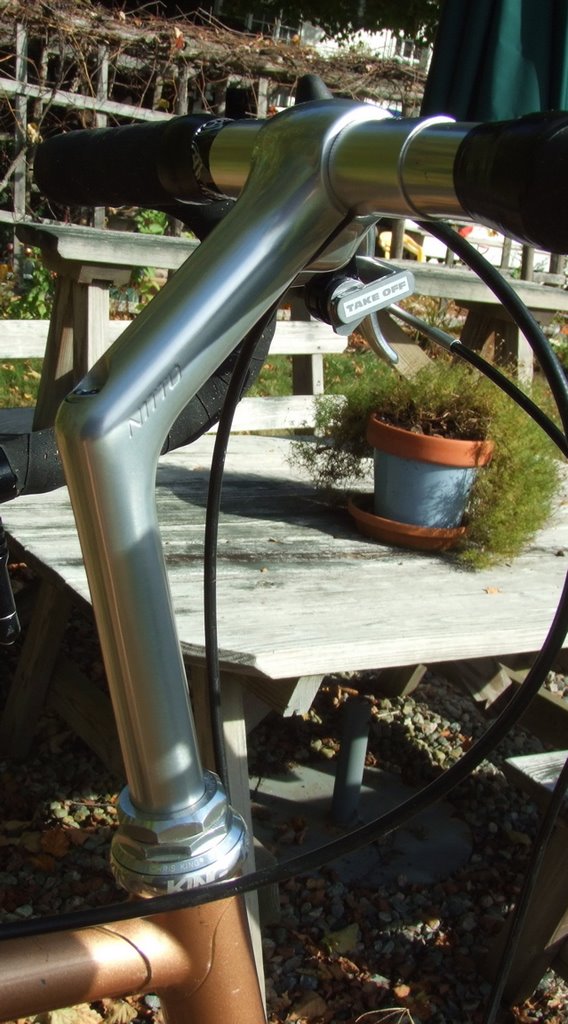
When I picked up the bike I happened to see a 68cm Rivendell Atlantis bike that was also in for service. It had a very high stem called a Nitto dirt drop. I asked if Harris had one for sale, and they did, so now I have my bars high enough and I don't have that ugly, kludgy, heavy, steel steerer extender no more!


So at this point, the only components that haven't been upgraded are the derailleurs, brakes, and wheels. The wheels are kind of a conundrum. The 126mm rear dropout spacing means that it's hard to find a good hub (although Phil Wood has one). Plus, because of my weight, a freehub would be a much better choice than a standard hub. Also, the current wheels are 630mm, while must replacements are 622mm. I'm not keen about dropping the bike by another 4mm, given the long 185mm cranks.

Or should I get a new bike? I love the look of the Rivendell Atlantis, which is available in a 68cm size. Or I could get Mike Flanigan to build me a custom. Or I could do the Peter Cole thing and get a used 68cm Cannondale touring frame.

Hmmmm.

Saturday, October 14, 2006

OK, maybe not...

So I actually went so far to go to the local Saturn dealer to price out the Saturn-badged version of the Montana (the Saturn Relay). But then I found out about the Relay was named to Forbes Magazine's list of the Ten Worst American Cars of 2006.

Oh well, guess we'll squeeze into the BMW for a while longer.

My little hiker


My older son is 3 1/2 years old, and for a while I've been taking him on little "adventures" in the woods. Mostly, these involve walks of perhaps a mile across mostly level ground.

On Thursday, however, we broke new ground by hiking to the summit of Noanet Peak in the Noanet Woodlands in Dover, MA. This hike is about three miles and includes a climb of about 250 feet. The summit is open, and offers a nice view of the Boston skyline.

He astounded me by making the entire hike without needing to be carried, including several steep rocky scrambles. He had so much energy on the way down, that he ran about 1/4 of the way!

This first sign that he and I will be able to enjoy the outdoors together has made me really, really happy!

Monday, October 09, 2006

Nitto "dirt drop" stem

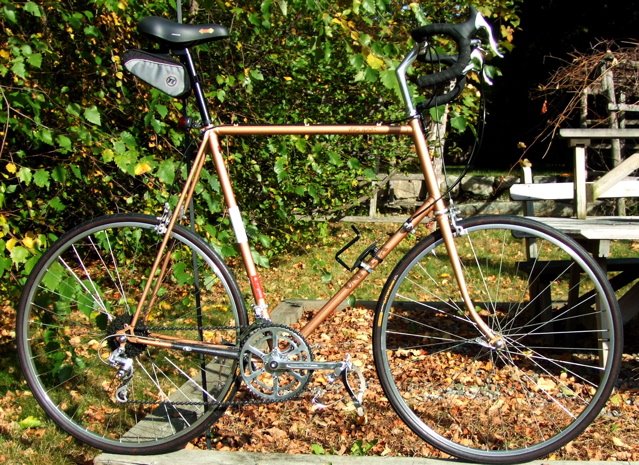
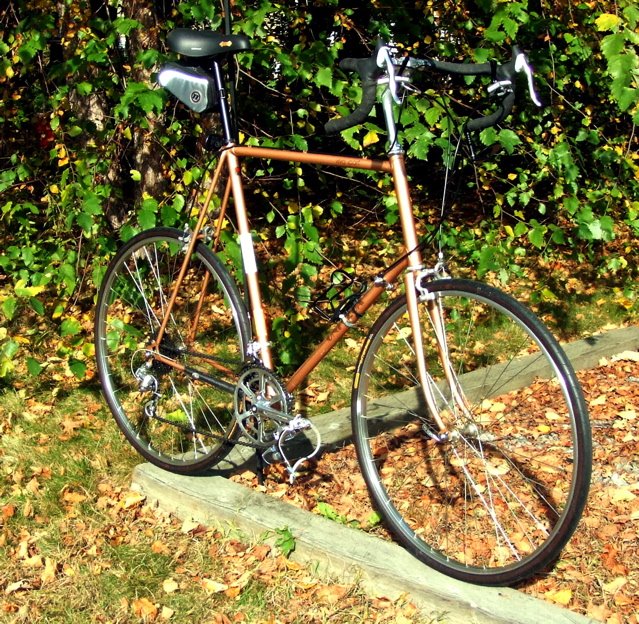
As discussed elsewhere, after a 25-year layoff, I've been doing some bike riding. When you're 6'9" tall setting up a bicycle (like lots of other things) isn't always straightforward. The bike frame that I'm using is the largest production frame ever made (68cm), but it's not big enough for me with normal components. Until recently, I had been using a steel steerer extender plus a Nitto technomic 100mm stem to get the handlebars high enough:


Last week, I had the bike in to Harris Cyclery in Newton to get a new Chris King headset installed, and when I picked up the bike I happened to see a 68cm Rivendell Atlantis bike that was also in for service. It had a very high stem called a Nitto dirt drop. I asked if Harris had one for sale, and they did, so now I have my bars high enough and I don't have that ugly, kludgy, heavy, steel steerer extender no more!


This makes me happy, because now I have a bike that is comfortable to ride, with decent components, and no obvious kludges:


Monday, October 02, 2006

Pontiac Montana SV6 Trounces Toyota Sienna

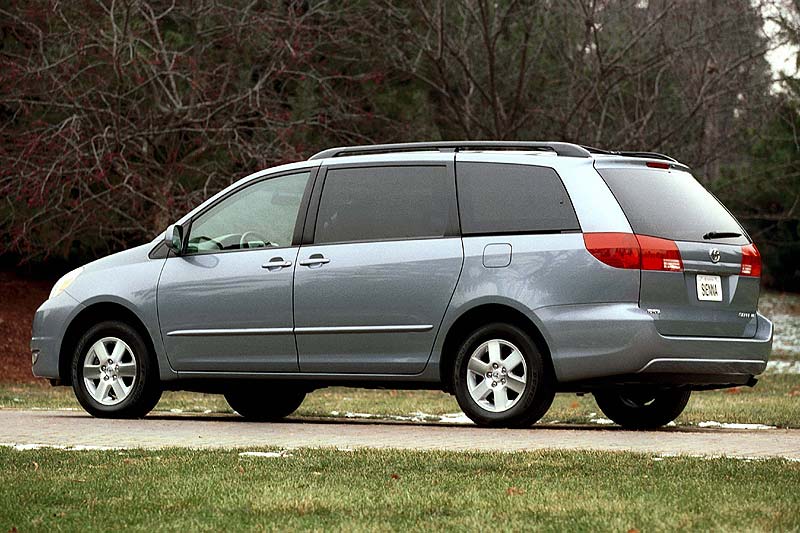
A significant personal upheaval recently took me to Las Vegas for a week, and while there I rented a minivan from Hertz. The first car they provided us with was a 2006 Toyota Previa:


Based on my experience owing a Toyota Matrix, I expected this car to be easy to operate, stone-reliable, and to have really uncomfortable seats. Well, I was right about the seats. Awful, cramped, squishy with absolutely no lower back support. But after driving for 15 minutes (temperatures in the low 80s F), the AC would stop working and the engine temperature would peg to the redline.

I took the car back to Hertz and they replaced it with a Pontiac Montana SV6 minivan:


This car was great! The driver's seat had enough travel and adjustment that I could get my 6'9" self comfortable, and the seat was supportive. The controls were simple to understand and clearly laid out. The on-board computer was especially nice. A set of three menu buttons atop the center stack, with a red alphanumeric display embedded in the speedometer. The driving dynamics were reasonable. Plenty of body roll made for slow transitions, and the tires had abysmal grip. Somewhat underpowered, with a lazy 4-speed automatic made for easy cruising. The AC worked perfectly on a trip through the mountains outside of Vegas to Hoover Dam.

All in all, I have to say I much preferred the Pontiac to the Toyota. If I were in the market for a minivan (which I might be, since the personal upheaval was my wife and I adopting a new baby), I'd be tempted by the Pontiac (or it's Chevy clone, the Uplander).

Monday, September 11, 2006

From the Archives: The tall bike 25 years ago

And now a word from the archivist:


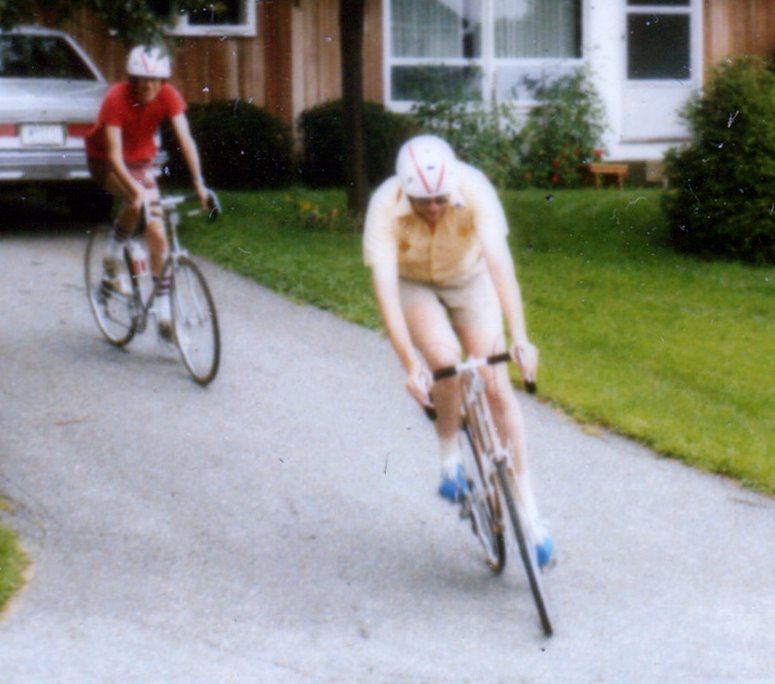
That's me on the bike in 1980 or so, in it's as-delivered state (except for the enormous, solid aluminum seat post). Note the tiny little handlebars, cramped up riding position, quaint Bell helmet, and those unbelievable electric blue Adidas sneakers...

From the Archives: My First Car

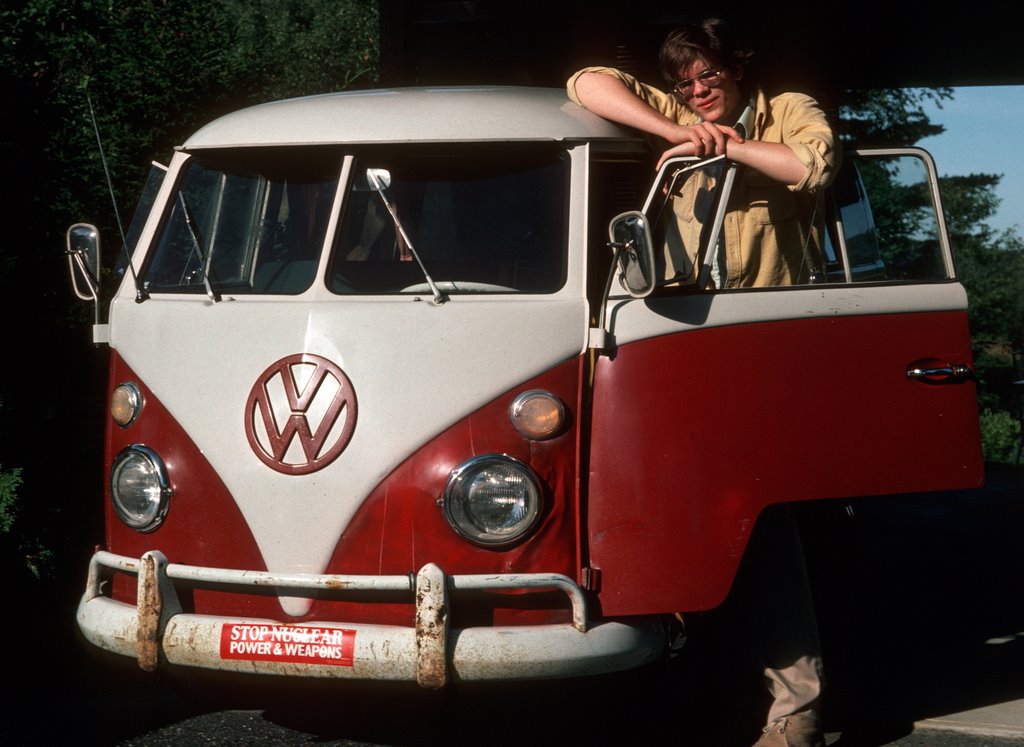
A 1966 VW Bus:


I think this had a claimed 60,000 miles on it when I bought it (for $1200). It powered me back and forth to Oberlin from New Hampshire, and also on adventures in the Maritimes, around Lake Superior, and elsewhere. I remember it being a bit of a tank, with such old-school technology as
  • Drum brakes all around
  • Kingpins
  • A 1-barrel Solex carb with oil bath air cleaner
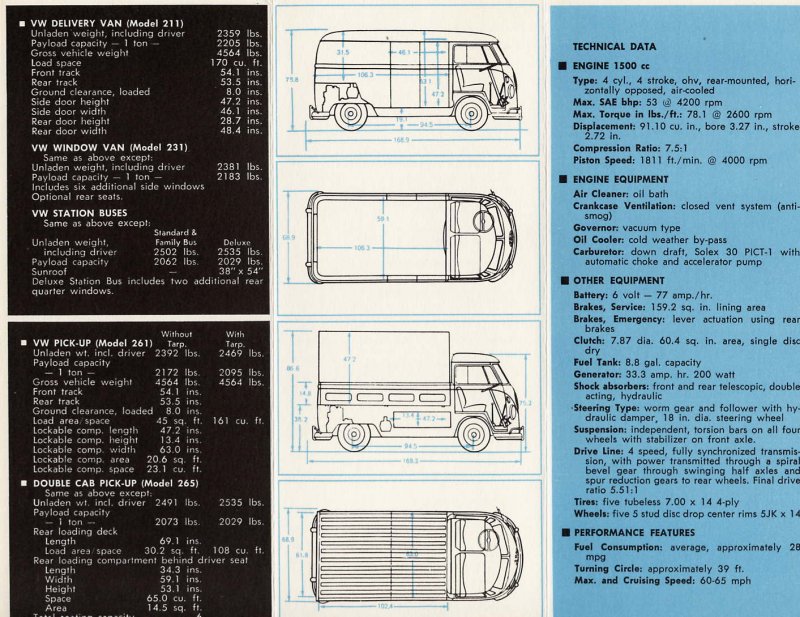
The most amazing thing is that it weighed less than my new Mini does: 2350 pounds empty, as you can see from this spec sheet:

Saturday, September 09, 2006

The tall bike project

I've been spending a lot of time working on my bike recently. After riding it for a short while with the upright MTB stem and riser bars using SRAM twistgrip shifters, I decided that:
  • It didn't handle well. The steering was extremely light and twitchy. I attribute this to the fact that the riding position put most of my weight over the rear wheel.
  • It wasn't comfortable. The trouble with the riser bars is that you don't have any choice of hand position, so I was finding that my wrist was getting stiff and sore.
  • It wasn't aerodynamic. When riding on the flat or downhill, I could feel the wind pressing against my chest.
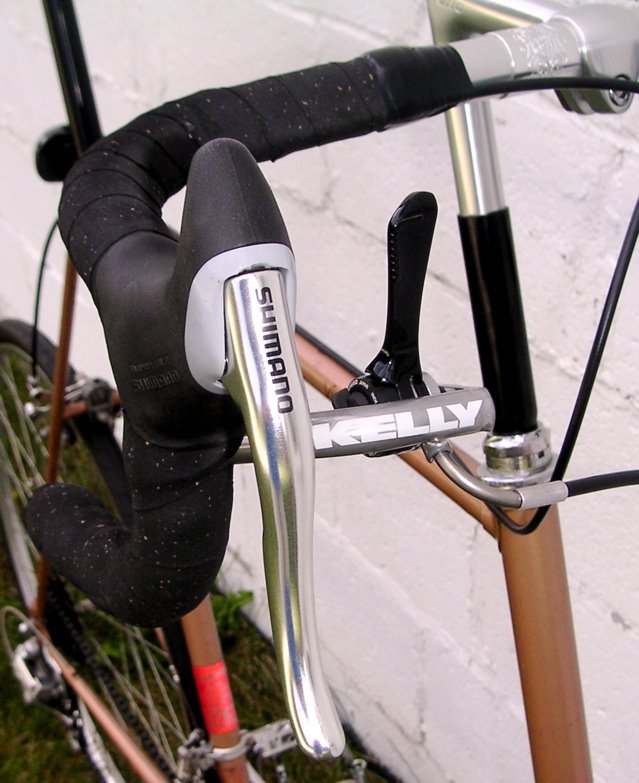
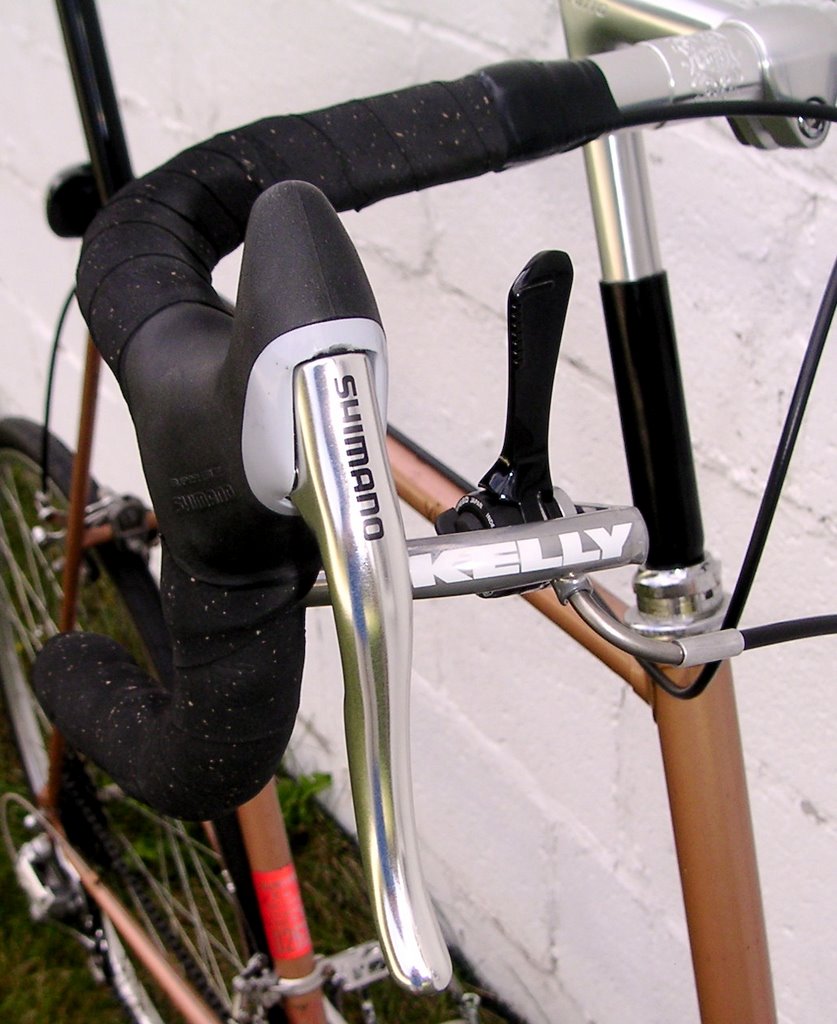
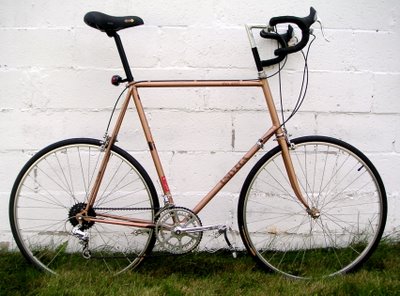
So I decided to re-do the bike using drop bars. The existing drop bars that were on the bike were tiny, and the existing stem was normal size, so the bars were too low. I decided to go with a set of 46cm Nitto noodle bars and a Nitto technomic stem. But even this combination put the bar too low for me. So I got a steel steerer extender which, when used with the Nitto stem, puts the bars about 2 cm below the level of the seat. I also got a set of Take-Offs from Kelly, which let me mount old-style friction shifters in a geezer-friendly location near the brakes. Despite how wacky they look, they're actually extremely nice to use:

As I started to think more about the fit of the bike, my attention turned to the crankset. The existing crank was a low-end three-piece crankset with steel chainrings and 170mm cranks. After reading various articles on crank length, I decided to see if I could come up with a set of 185mm cranks for the bike. But, as with all of these upgrade paths, there were constraints. First, I didn't want to change the front derailleur, so that meant sticking with a double. Second, I didn't want to change the chain or the cluster, so that meant avoiding hyperglide or ulgtraglide chainrings.

Harris had a promising solution: a set of vintage 185mm TA Vis Pro 5 ("cyclotouriste") crankarms.

Unfortunately, they did not have chainrings that would allow me to maintain the current gearing on the bike (which I like, chart appended below).
---------------------------------------------------------------------------
SP CRxFW GI GIdf DI diff DF PRPM RT
---------------------------------------------------------------------------
1> 40x32 33.75 14.29% 106.03 15.15 8'10.03" 597.57 1:1.25
2> 40x28 38.57 13.75% 121.18 16.66 10' 1.18" 522.88 1:1.43
3> 52x32 43.88 2.56% 137.84 3.53 11' 5.84" 459.67 1:1.62
4> 40x24 45.00 11.43% 141.37 16.16 11' 9.37" 448.18 1:1.67
5> 52x28 50.14 7.69% 157.53 12.12 13' 1.53" 402.21 1:1.86
6> 40x20 54.00 8.33% 169.65 14.14 14' 1.65" 373.48 1:2.00
7> 52x24 58.50 8.60% 183.78 15.80 15' 3.78" 344.75 1:2.17
8> 40x17 63.53 10.50% 199.58 20.96 16' 7.58" 317.46 1:2.35
9> 52x20 70.20 9.89% 220.54 21.81 18' 4.54" 287.30 1:2.60
10> 40x14 77.14 7.06% 242.35 17.11 20' 2.35" 261.44 1:2.86
11> 52x17 82.59 21.43% 259.46 55.60 21' 7.46" 244.20 1:3.06
12> 52x14 100.29 0.00% 315.06 0.00 26' 3.06" 201.11 1:3.71
---------------------------------------------------------------------------
SP CRxFW GI GIdf DI diff DF PRPM RT
---------------------------------------------------------------------------

But I found a fellow in Toronto (Bicycle Specialties) who had a stock of TA Cyclotouriste rings, so I had him send me the rings and the mounting hardware.

Next stop was a new bottom bracket. The experts at Harris (Jim, Sheldon, and Dave) put their heads together and decided that a 116 (+5 asymmetry) Phil Wood bracket would work for me. Pricey at $112 plus two mounting rings and two Phil consumer tools.

When I got this home, I obsessed for a long, long time about whether this setup was going to work. There are a lot of considerations when selecting a bottom bracket, especially when you have long feet and you're sticking ginormous 185 cranks on an existing bike:
  • Chainline
  • Front derailleur operating limits
  • Clearance between pedal and ground, which is related to
  • Q-factor (tread)
  • Interference between rider's heel and rear derailleur
  • Clearance between crankarms and rear wheel stays
  • Interference between rider's toe and front wheel when turned
And the problem is that there's no way to tell if it's going to work without actually installing it on the bike. Which means your pristine $112 Phil Wood bottom bracket ain't going to be so pristine when you take it back to exchange it. Plus, of course, you cannot assemble and disassemble the crankset without an appropriate crank puller, which in the case of a TA crank takes a 23mm (as opposed to the normal 22mm) thread. This is not a case of blame the contrary French, however, as the TA crank predates the other cranks that used 22mm.

Now there are two suppliers of 23mm crank pullers, Park tool used to make a reversible 22/23mm puller with handle and VAR still does, although their distribution in the US is spotty. Turns out that Harris didn't have one of these, but VELO Orange did.

In order to minimize potential pedal-to-ground interference problems (all of the technical advisors to whom I spoke had the same response: "Don't pedal through the turns, buddy"), I bought a set of MKS platform pedals, which are narrow and slightly shallower than the non-name touring pedals that had been on the bike. Plus, they take 'standard' MKS toeclips.

So last night I put this whole thing together, and the end result is pretty amazing: The chainline is quite close in, the crank arms clear the rear stays by just 3 or 4 mm, and my feet clear the derailleur. Because of the closer Q-factor and the smaller pedals, I have at least as much pedal clearance through turns as I did before. The only real interference is toes-to-pedals, which is a non-issue above parking lot speeds.

Parenthetically, I would note that this upgrade has been extremely satisfying on a personal level. From the moment I first acquired the bike about 25 years ago, I was not satisfied with the crankset. I disliked the cast-in-place nonremovable chain guard, the heavy steel chain rings, and the fact that the damn thing was warped.

Sweet new TA crankset


Nasty old "custom" crankset

I never had the time or money when I was a kid to go through the rigmarole of putting on a proper crankset (and before the whole internet thing, living up in the woods of New Hampshire, it would have been impossible to find the components anyway.)

Anyway, the only thing left to do now is take it out for a ride!

Which I did. It works well, and is very comfortable. Biggest problem is that the front shifting requires more finesse than the old chainrings. In particular, if you don't downshift firmly and with an appropriate amount of pedaling force, the chain gets hung up on the inner ring, and then wedges itself into the chainstay.

Selling MINIs

I'm writing this in the waiting lounge at MINI of Peabody, while I'm waiting for my car to get its oil changed. I've had the car for about three and a half months but only put on about 2700 miles. I'm scheduled to do a track event at Lime Rock in two weeks, and because I'm so lazy I've hired MOP to do the change.

I had a beautiful drive up this glorious sunny Saturday morning, and a nice chat with Hrach, the legendary MOP "Motoring Advisor".

Next door to where I'm sitting, the MOP sales staff is having their morning sales meeting with the dealership manager. Here are some snippets from this morning's order of battle:
We have got a lot of used cars to move. We've got a bunch of overaged cars here. Whatever cars we don't sell by the end of the month are going to auction.

So we're having a special contest, and a special bonus for these cars. You will get an extra $100 for each car you sell. If you sell five, you get the $500 plus another $500. And we're having a contest. The person who sells the most of these cars gets an additional $1000, so the maximum possible bonus, plus your regular commission, is $2000.

This should be great motivation for you guys.
It's always interesting to get a glimpse at how the sausage gets made.