Showing posts with label cars. Show all posts

Wednesday, April 01, 2009

Living the high life...

... in my El Camino Super Sport.


Tuesday, December 05, 2006

"If you're going the minivan route, you wind up with the Odyssey"

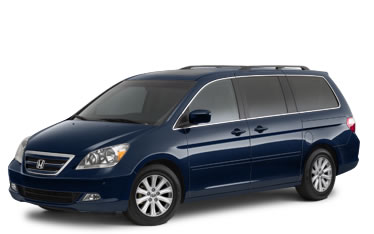
That's what our friend Maureen says anyway. It turned out that way for us, as we just traded in the grey BMW wagon for a 2007 Odyssey:

Here's how we got there.
Step 1: Enough legroom for tub (who is 6'9" tall):
  • Caravan SXT -- excellent
  • Pontiac SV6/Saturn Relay/Chevy Uplander/Buick Terraza -- excellent
  • Honda Odyssey -- adequate
  • Hyundai Entourage/Kia Sedona -- barely adequate
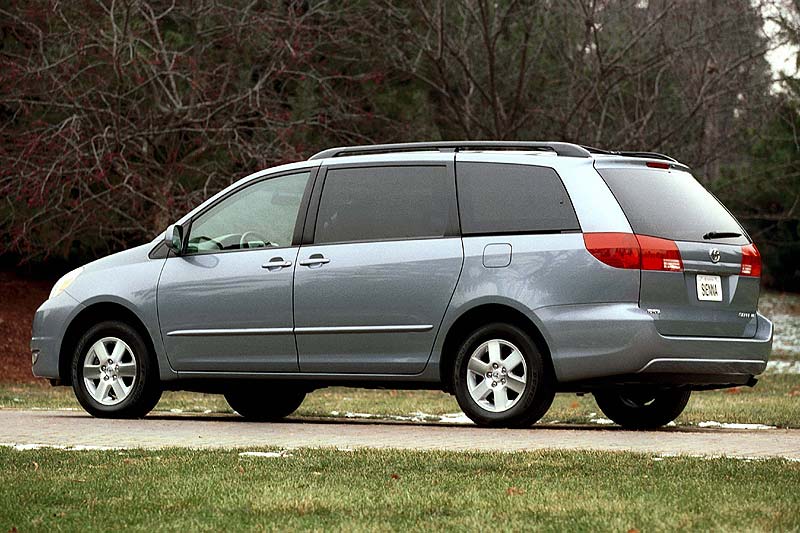
  • Toyota Sienna -- hopelessly inadequate
Not evaluated: Ford Windstar, Dodge Sprinter

Step 2: Basic driving dynamics?
  • Caravan: Marginal handling, with vague sloppy steering. Excellent throttle response and very crisp shifting from a 4-speed manual transmission. Lots of road noise.
  • GM: Terrible handling with excessive body roll. Poor throttle response, sluggish 4-speed transmission, and marginal overall power.
  • Hyundai/Kia: Adequate handling and throttle response, reasonably quiet. Smooth-shifting 5-speed transmission.
  • Honda: Smooth handling, shifting. Adequate power. OK ride. Not particularly quiet.
Step 3: Research
  • Caravan: Poor reliability, poor resale value. Excellent incentives ($4000 cash rebate) and reasonable base price. Mediocre mileage (18/25)
  • Honda: Average reliability. Good gas mileage (20/28) with EX-L and Limited trim. No incentives and relatively high base price. No options.
  • GM: Named by Forbes magazine as one of the 10 worst cars you can buy in America due to abysmal reliability scores.
  • Hyundai/Kia: Unknown reliability (new model). Anecdotes from edmunds.com not promising. Mediocre mileage (18/25) with anecdotal reports of much poorer mileage.
Step 4: Extended test drive
  • Caravan: Rented a white 2007 SXT from Enterprise for a weekend trip to New Hampshire. Versatility of stow-and-go seating was excellent. Tons and tons of room for people and stuff. Very relaxed driving experience. Very secure during a torrential rainstorm (kept up 65-70 MPH under abysmal conditions without trouble). Controls were extremely simple to use. Front seats offered zero lower back support, with squishy cushions and revolting fabric colors. Dashboard and interior materials cheap in the extreme. Somewhat bouncy ride, and not especially quiet. Wife declares "no way" because of the uncomfortable seats.
  • Honda: Borrowed a 2007 EX from Bernardi Honda for the day. Very pleasant, car-like driving experience with good visibility. Controls somewhat complex. Seats comfortable. Reasonably quiet. No problems.
Step 5: Model selection
  • LX: Manual front seat doesn't offer as much legroom as power seat in EX and above, so scratch this.
  • EX: Cloth seats only. Not good for 3 year-old who requires continuous feeding.
  • EX-L: About $2500 more. Leather seats plus variable-cylinder control motor for better mileage, and sunroof.
  • Touring: Another $2500 gets you fog lights, lazy susan underfloor storage, power liftgate, and run-flat tires with an oddball wheel size.
So, EX-L it is.

A few testing highlights:

Best Feature:
Dodge Caravan power doors: Switches work easily but you can always open and close the door manually (it has a simple clutch mechanism). Contrast this with the Honda, where you must disable the power doors to use them manually.
Biggest Surprise:
The Hyundai looks great on paper, and it's gotten great reviews from media as diverse as Consumer Reports and the New York Times, but it is as unrefined and crude as a pickup truck (and that includes the dealership experience).
Where Honda is Behind:
A separate key fob for the remote controls. Even the Dodge has the buttons integrated into the head of the key.

Monday, November 20, 2006

The best Porsche 911


Well my 1988 non-sunroof coupe, naturally, but why?
  • It has a galvanized body shell, which means that, in general, rust isn't a problem. Porsche started galvanizing with the 1975 model year. Some would say that this makes 1974 the absolutely worst year, since it has the heavier bumpers without the compensation of a rust-free body.
  • It has a 3.2 litre engine, which is the largest possible displacement using the original case (given the size of the case and the spacing of the bore centers). The 3.6 litre engine introduced with the 1989/90 C2/C4 964 cars uses funky offset head studs to achieve its displacement (which in turn led to the oil leak problems on the early cars).
  • It has simple digital engine controls, which means no points to adjust or replace, and long-life spark plugs. Throttle response is excellent with a single oxygen sensor, and the power is good (217 BHP) if not spectacular. It is very nearly completely user-serviceable, with the only microprocessor in the car being contained within the DME brain. All the mechanical bits are essentially the same as a pre-electronics car.
  • It has no ABS. The 964 introduce ABS to the Porsche 911, but ABS requires close to zero-offset steering. This meant that the Fuchs wheels wouldn't fit. The zero-offset geometry also meant that the cars needed power steering. Which made them heavier. Which led to the development of the 3.6 motor. See above.
  • It has torsion bar suspension. This means a nice roomy trunk in the front (unlike later cars).
  • It, along with other 87-89 cars, has the best legroom of any Porsche 911 ever made. The G50 shift linkage puts the shift lever further from the steering wheel than in earlier (915) cars, while the seat track is mounted lower and further back than in both pre-1986 and post-1989 cars. The 86-89 cars include small recesses in the central tunnel to allow the seats more travel, while the post-89 cars have airbags, which cause the designers to limit seat travel so as to guarantee good performance for unbelted drivers.
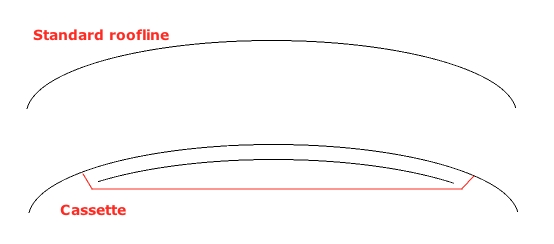
  • It has no sunroof. This means an extra 3" of headroom, plus about 30 pounds less weight up in the roof of the car. Three inches? Really? Yes, because of the shape of the 911 roof, the movable panel in the sunroof has to drop significantly in its rearward travel. The sunroof mechanism includes a steel box into which the panel travels, and this box forms a chord across the otherwise highly arched roof:
  • It has no air conditioning. The pre-1990 Porsche 911 AC system is a Rube Goldberg monstrosity that includes a huge compressor hung out over the tail of he car, one condenser mounted on the engine cover (where it thoughtfully pre-heats the intake and cooling air charge and where the constant hose flexing leads to leaks) and a second condenser mounted underneath the front bumper, so perfectly hidden from airflow that a blower is required to draw air from behind the front bumper and blow it down through the condenser). The evaporator is mounted in front of the footwell, and it only operates in recirculating mode, drawing air from the footwell, cooling it, and blowing it out the dash vents (which means that no fresh air comes out the dash vents). These components are strung together with about 20 feet of AC hose. Without this system in place, and with the dash vents replumbed to blow fresh air, the car is about 70 pounds lighter and frankly more comfortable to drive.
So in summary, this 911 - which is really one of a kind -- is about the best there is. It has the classic looks (except for the modern bumpers, which are only available if you accept the rust problem, plus less legroom), it is only about 150 pounds heavier (bumpers, sound deadening, a couple of extra heater blowers) than the lightest of the early cars), and it has the highest power rating of any user-serviceable 911 (to get more, you either need devilishly complex MFI or soul-sucking modern engine management).

Sunday, October 22, 2006

Air

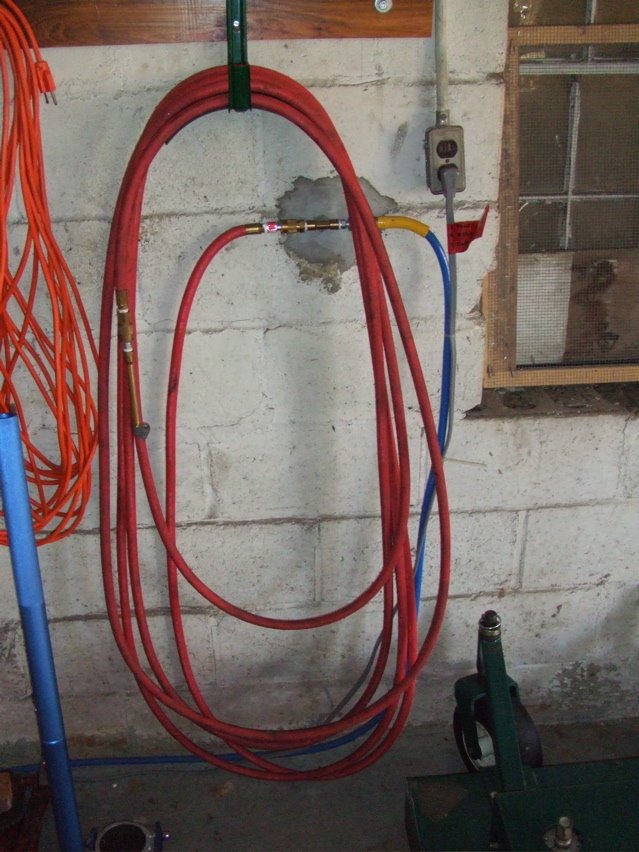
As the seasons change, and temperatures start to fall, the air pressure in a car's tires begins to fall. Typically, about 1 PSI per 5 degrees Fahrenheit. Finding a gas station that has a working, free supply of compressed air can turn what should be a five minute chore into a 30 minute hassle.

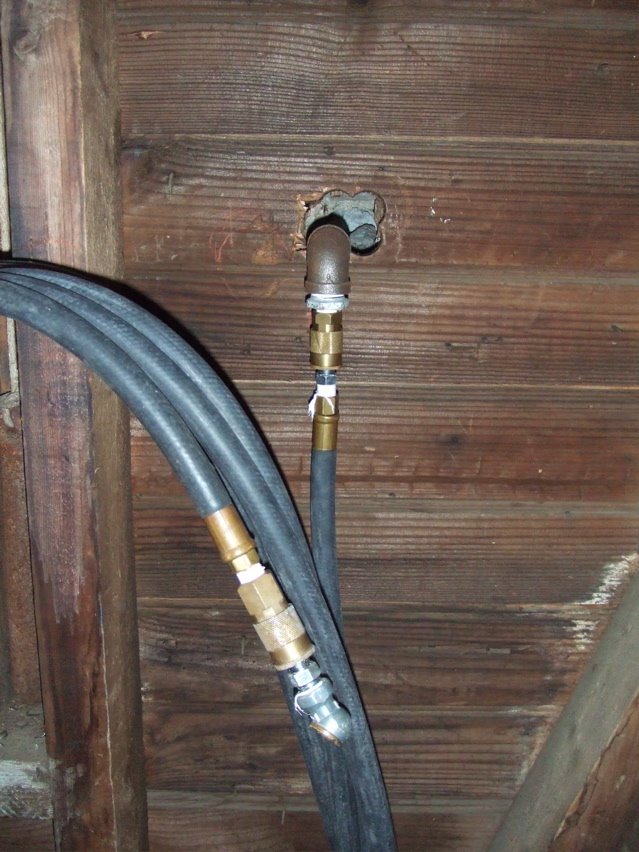
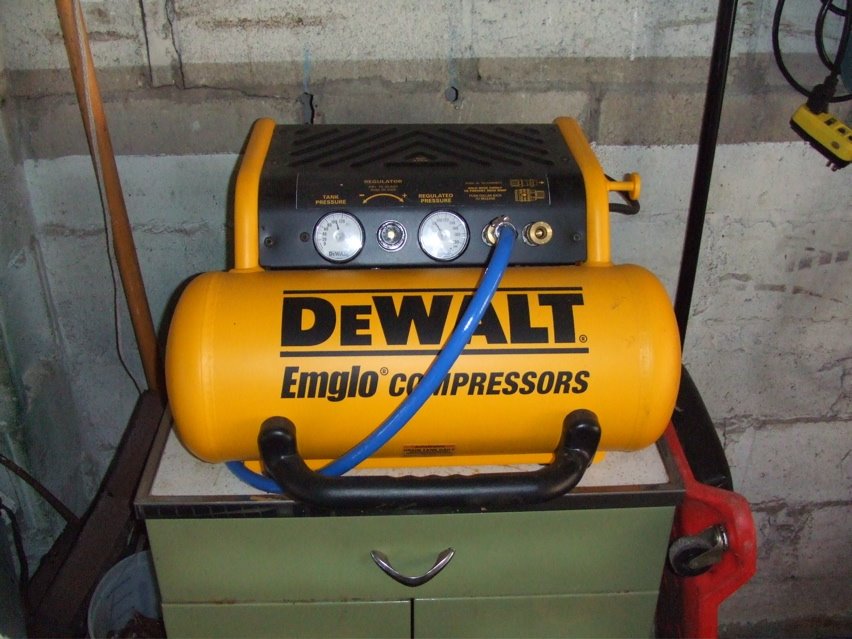
Our house has a bifurcated garage -- a small wood-framed two-car garage next to a big cinderblock structure -- and a couple of years ago, I decided to install a source of compressed air. I have a small contractor's compressor which is plumbed into a pair of hoses, one in each garage:


The compressor is a small, oil-lubed compressor intended for nailguns. I use it to pump up tires and run an impact wrench. It will run any kind of an air tool except for a drill, air-chisel, or cut0ff tool.


What I like about it (as opposed to a "normal" large-capacity shop compressor) is that it does every automotive chore for which compressed air is required (blowing out fuel lines, running an impact wrench, and blowing pistons out of brake calipers). The things that it doesn't do, can be done using electric tools. Because it is small, it builds pressure quickly (like 20 seconds from empty), so when it's time to pump up the tires, you're up and running quickly. With a big shop compressor, you have to waste the time and energy of pumping up the whole tank before you can do anything.

Saturday, October 14, 2006

OK, maybe not...

So I actually went so far to go to the local Saturn dealer to price out the Saturn-badged version of the Montana (the Saturn Relay). But then I found out about the Relay was named to Forbes Magazine's list of the Ten Worst American Cars of 2006.

Oh well, guess we'll squeeze into the BMW for a while longer.

Monday, October 02, 2006

Pontiac Montana SV6 Trounces Toyota Sienna

A significant personal upheaval recently took me to Las Vegas for a week, and while there I rented a minivan from Hertz. The first car they provided us with was a 2006 Toyota Previa:


Based on my experience owing a Toyota Matrix, I expected this car to be easy to operate, stone-reliable, and to have really uncomfortable seats. Well, I was right about the seats. Awful, cramped, squishy with absolutely no lower back support. But after driving for 15 minutes (temperatures in the low 80s F), the AC would stop working and the engine temperature would peg to the redline.

I took the car back to Hertz and they replaced it with a Pontiac Montana SV6 minivan:


This car was great! The driver's seat had enough travel and adjustment that I could get my 6'9" self comfortable, and the seat was supportive. The controls were simple to understand and clearly laid out. The on-board computer was especially nice. A set of three menu buttons atop the center stack, with a red alphanumeric display embedded in the speedometer. The driving dynamics were reasonable. Plenty of body roll made for slow transitions, and the tires had abysmal grip. Somewhat underpowered, with a lazy 4-speed automatic made for easy cruising. The AC worked perfectly on a trip through the mountains outside of Vegas to Hoover Dam.

All in all, I have to say I much preferred the Pontiac to the Toyota. If I were in the market for a minivan (which I might be, since the personal upheaval was my wife and I adopting a new baby), I'd be tempted by the Pontiac (or it's Chevy clone, the Uplander).

Monday, September 11, 2006

From the Archives: My First Car

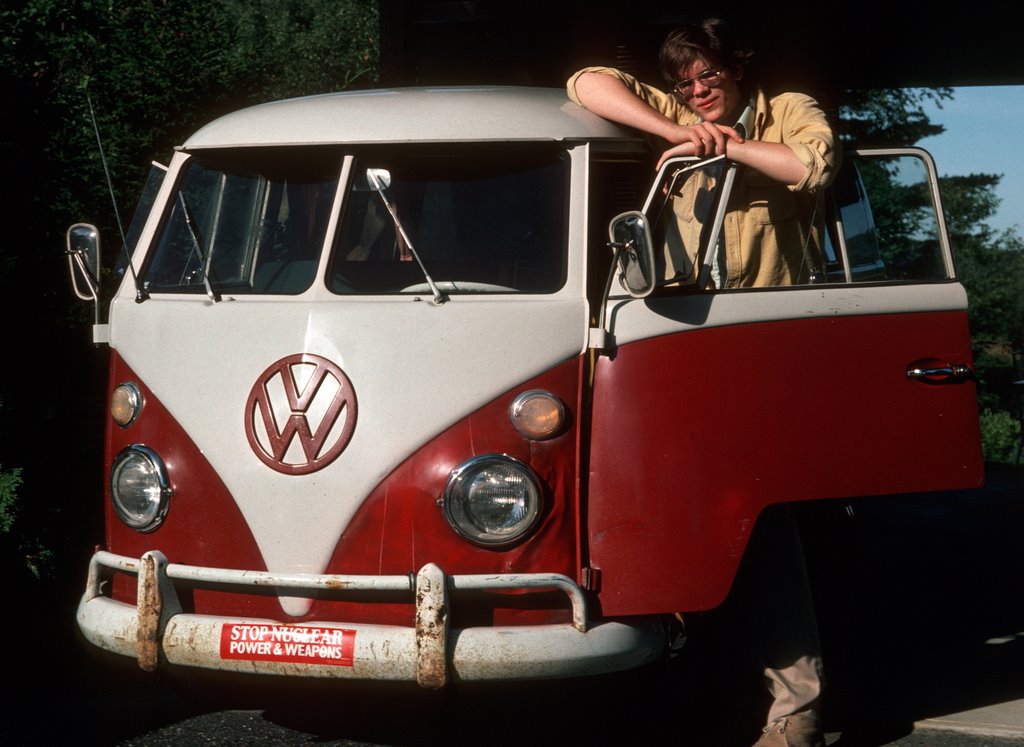
A 1966 VW Bus:


I think this had a claimed 60,000 miles on it when I bought it (for $1200). It powered me back and forth to Oberlin from New Hampshire, and also on adventures in the Maritimes, around Lake Superior, and elsewhere. I remember it being a bit of a tank, with such old-school technology as
  • Drum brakes all around
  • Kingpins
  • A 1-barrel Solex carb with oil bath air cleaner
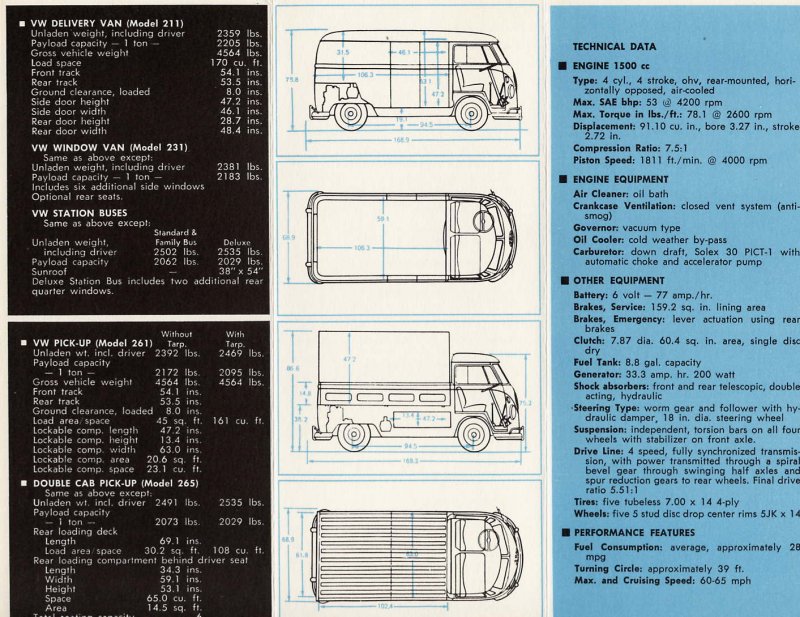
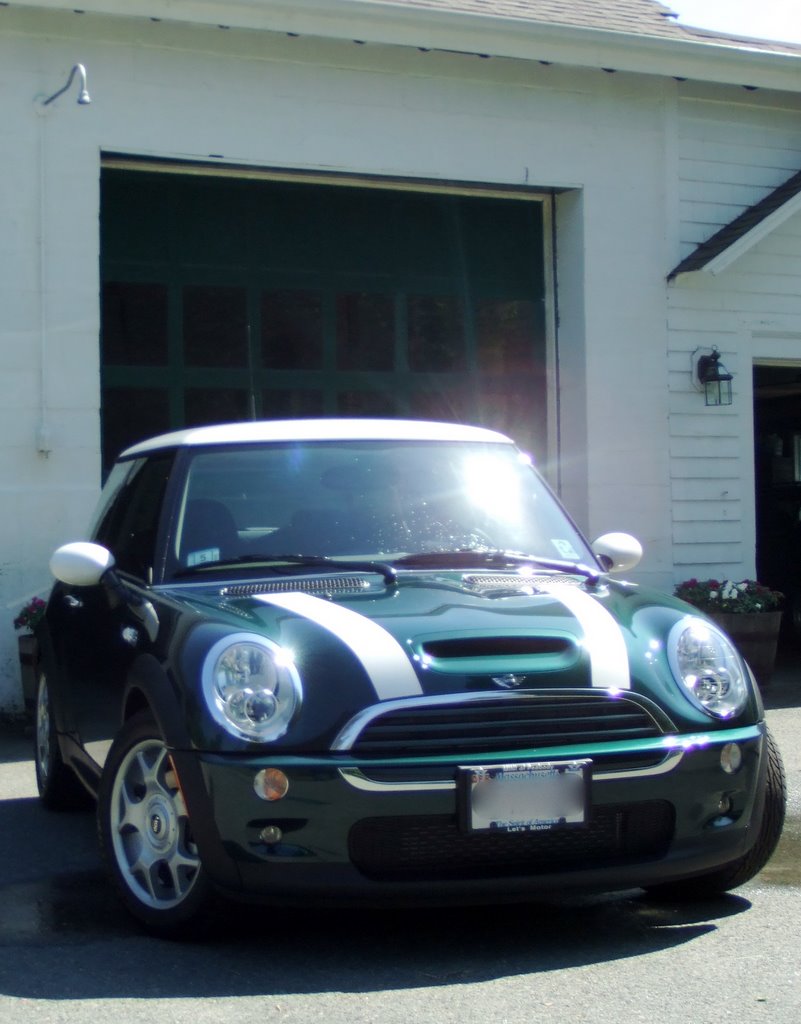
The most amazing thing is that it weighed less than my new Mini does: 2350 pounds empty, as you can see from this spec sheet:

Saturday, September 09, 2006

Selling MINIs

I'm writing this in the waiting lounge at MINI of Peabody, while I'm waiting for my car to get its oil changed. I've had the car for about three and a half months but only put on about 2700 miles. I'm scheduled to do a track event at Lime Rock in two weeks, and because I'm so lazy I've hired MOP to do the change.

I had a beautiful drive up this glorious sunny Saturday morning, and a nice chat with Hrach, the legendary MOP "Motoring Advisor".

Next door to where I'm sitting, the MOP sales staff is having their morning sales meeting with the dealership manager. Here are some snippets from this morning's order of battle:
We have got a lot of used cars to move. We've got a bunch of overaged cars here. Whatever cars we don't sell by the end of the month are going to auction.

So we're having a special contest, and a special bonus for these cars. You will get an extra $100 for each car you sell. If you sell five, you get the $500 plus another $500. And we're having a contest. The person who sells the most of these cars gets an additional $1000, so the maximum possible bonus, plus your regular commission, is $2000.

This should be great motivation for you guys.
It's always interesting to get a glimpse at how the sausage gets made.

Tuesday, August 22, 2006

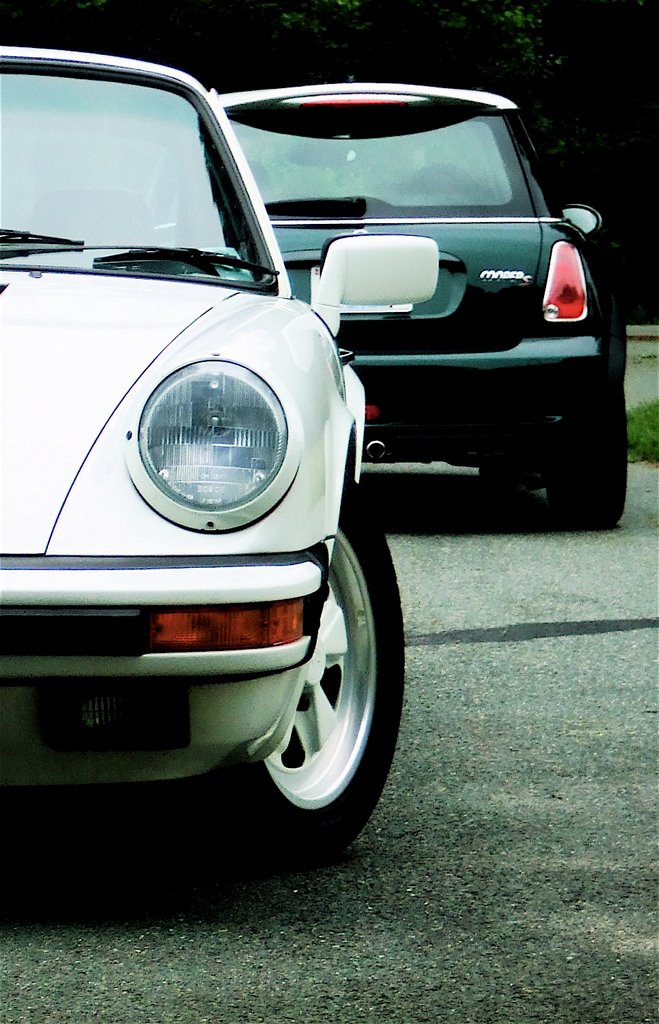
Just a little arty shot of the Porsche and the Mini in the driveway.

Can a car make you happy?

Maybe not.

But it doesn't hurt.

Sunday, August 20, 2006

Poor, stupid (but not hapless or hopeless) Ford

Unlike GM, Ford seems to be facing up to the reality that the age of the gas guzzler is finally gone.

Also unlike GM, they have a reasonable passenger car and crossover range:
  • Fusion (aka Mazda6)
  • Edge (reskin of Mazda CX-7)
  • 500
  • Freestyle
What they're missing of course is a decent subcompact and a B-car. When are they going bring over the (no longer) new second-generation Focus, and what about the Ka and Fiesta.

I give Bill Ford credit for telling some truth here:

As you know, our response to the challenges to our business is the subject of ongoing speculation in the news media, on Wall Street, and in our own hallways and lunchrooms. That's to be expected at a time of great change in our industry and renewed urgency among all of us.

That's why I want you to hear directly from me how I view our situation. First of all, the company's top priority remains the turnaround of our North American operations. As I said when we released our second quarter financial results, Mark Fields and his leadership team are accelerating their efforts, and we expect to tell you in the next couple months what additional measures we will take. These measures may be difficult, but are necessary.

Secondly, I will continue to evaluate the rapidly changing landscape of our industry and review the best ways in which we should adjust. That's why I've hired Ken Leet to assist me and our senior management team in evaluating our business and exploring strategic options. You can read more on Ken in the news release below.

Contrary to speculation, nothing has been decided and we will not rush to judgments. I'm proud of the progress that our operating units and brands around the world are making. Nearly all of them have been through turnaround efforts and have improved as a result. They will continue to pursue the strategies that have guided their progress.

And, as we've said before, Ford Motor Credit Company is a strategic asset to Ford that generates solid profits and dividends. The automotive financing unit continues to have strong business fundamentals and provides key support for Ford vehicle sales worldwide.

It is prudent in a time of rapid change in our industry for us to carefully examine all of our options. In the meantime, however, all of us must continue to remain focused on doing our part to get our company on the path to sustained profitability and success.

Thank you for your continued support of Ford Motor Company.

Bill Ford

Tuesday, August 15, 2006

Traffic safety program unlikely to work in Mass

In an attempt to reduce accidents followed by tailgating, Washington state DOT officials...

...painted dots 80 feet apart and posted signs telling drivers to stay at least two dots -- 160 feet -- from the vehicle ahead, based on the traffic safety principle of being at least two seconds behind another vehicle when going 60 mph.

Long backups developed Saturday, the day after the program began, when drivers slowed down because of heavy traffic and continued to maintain the two-dot separation, although that much distance was not necessary at slower speeds, said Lisa Mordock, a Transportation Department spokeswoman.

Can you imagine. People actually

(a) followed the instructions on a road sign
(b) maintained a safe following distance
(c) didn't cut each other off

Read the full story here.


Monday, August 14, 2006

Poor, poor, hapless, helpless, stupid GM

Hummer ads fight 'misconceptions' (or, if you don't have a Wall St. Journal subscription, see the original press release).

It's enough to break your heart. GM brings out the Hummer H3 as a way to broaden the affordability and appeal of the Hummer brand, but at a lower price point. Gas goes to $3 a gallon, and suddenly there's a Hummer backlash. Now the 'affordable' ($30,000+) and 'economical' (20 MPG, if you get the lame 5-cylinder motor) Hummer is left out in the cold.

I mean the thing sure looks economical, compact, and environmentally friendly to me:


Plus you get the gunsight windows, high step height, and an interior that's so cramped there's no place for a spare.

Tuesday, August 08, 2006

The best car in all the world...

My Alexander Technique teacher and I were talking cars the other day. She said that she owns the bestest car in all the world: a first-generation Toyota Rav 4:


Why? Because of the "styling".

But she also said that she used to own a car that was also the bestest in all the world: 1963 Dodge Dart.


I concur. The chirr-chirr-chirr of the starter, the gimcrack chrome trim, the fake wire wheel hubcaps with fake knockoffs, the square speedometer, pushbutton shifter...

Saturday, July 29, 2006

Car to hurry in

Yesterday, late for a meeting, I found myself needing to travel from an outer suburb of Boston (Natick) to an inner suburb (Newtonville) in a hurry. This turned out to be a perfect application for the Mini Cooper S.


Each control (steering, throttle, and brake) has immediate response and prodigious range. As soon as you see a gap in traffic, you can fill it. Not just because the car is small, but it's also fast and it changes direction quickly.

The only limiting factor is how obnoxious the driver is willing to be.

Wednesday, July 26, 2006

Small cars

As you can see by the list of cars I've owned (and that I now own), I like small cars. This is ironic, of course, since I am anything but small myself. Now that I drive the Mini on a daily basis, I get a lot of razzing about being so tall while driving such a small car.

I'm not sure why I like small cars so much. They're generally fun to drive, since they have low polar moment and less inertia sloshing around. I like that making a car lighter creates a positive feedback loop (a lighter car can use smaller brakes, which makes it lighter, which means it can use a smaller engine, which makes it lighter...).

People often wonder why, since I'm so tall, I don't drive a big car or SUV. Being 205cm tall, the first thing I look for in a car is how roomy it is for the driver, and I have not found any correlation between exterior size and interior room. Some cars that I have looked at that have excellent room:
  • Mercedes E-class, S-class
  • BMW 3-series and 5-series
  • Mini Cooper
And some cars that have rotten interior space:
  • Porsche Cayman
  • Porsche 911 (1965-1986, 1999-on)
  • Ford Explorer/Expedition
  • Nissan Quest
Being tall has kept me out of some cars that I would have loved to own:
  • Formula Ford
  • Mazda Miata

Tuesday, July 11, 2006

Extremely lame Mini swag

I received my "Motoring Welcome" kit in the mail from Mini yesterday. Truly some of the lamest swag ever:

- "Buy a Mini" trading cards to hand out to my "like-minded" friends
- Window placards with such charming messages as "Hey, Sexy"
- A cheesy ballpoint pen
- A really cheap Moleskine knock-off notebook from China
- Various come-ons for Mini financing
- A duplicate roadside assistance card

The only remotely cool item was two "Interstate Bingo" cards. Of course they were bent in half by the ape who packed the box.

Friday, July 07, 2006

Garage Queen

Well not really, but ever since I got the Mini, I only take the Porsche out for fun, and only on nice days.

Thursday, July 06, 2006

911 Handling

The Porsche 911, especially the pre-964 cars (1965 through 1989, except the 1989 Carrera 4), have a bad reputation for handling, particularly unexpected oversteer.


The first time I took my 911 on the track, it was with a fair bit of trepidation. But I found that when driven normally, it handled wonderfully. Brake steadily for the turn, begin turn in while the brakes still on (to get some weight on the front), then steady throttle to the apex, followed by full throttle from the apex to the exit. At any point in the turn, minor throttle adjustments can be used to trim the line. Perfect, just like a race car.

I've done a fair amount of racing and time trialing, and I've also done a lot of instructing at BMW and Porsche driver schools, and I would say that a Porsche 911 also serves as an excellent error amplifier. For example, if you get on the throttle before the car is turned into the corner, you will experience tremendous understeer. React by cranking in more lock and easing off the gas and you will experience a dramatic shift to oversteer (as the cranked front wheels find grip) followed by tail-first exit. Or if you come in to a turn too hot, turn in to early, then get off the gas in mid turn, same scenario.

But in the hands of a capable driver, what a thrill:


Saturday, July 01, 2006

Spare tires

My BMW has the best spare tire in the world: The spare wheel is an OEM alloy that matches the four on the car, as does the tire, a 235/45-17 Michelin Pilot. Any kind of flat tire or wheel damage and I can pop on the spare and continue my journey for any distance at any speed. If the tire must be replaced, it is a standard size available anywhere.

The Porsche has a temporary service spare which must be inflated using a pump prior to use. It has restricted speed and distance limits.

The Mini has no spare. The tires are run-flats, which can be driven on with zero air pressure for a limited distance (120 miles) at a limited speed (50 MPH). Once they've been run flat, they must be replaced. They are not commonly available, especially outside of the core Mini markets (the Northeast, California, and the Pacific Northwest).

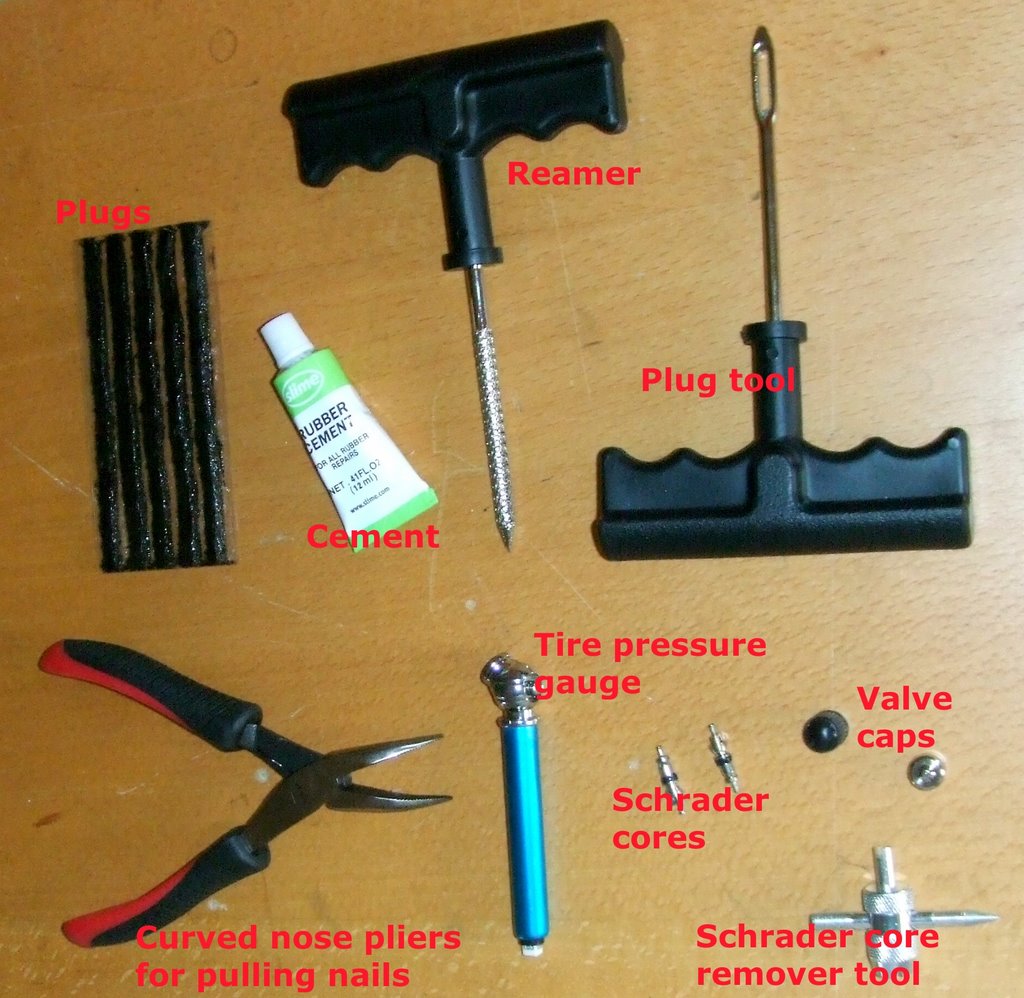
The two types of tire problems that I've experienced in my motoring career (not counting delaminating retreaded tires) have been slow-to-fast leaks caused by nails in the tread and catastrophic loss of pressure caused by bending the wheel rim on potholes. The former can typically be repaired, and as long as you keep pumping up the tire, aren't a big deal. The latter, of course, require a new tire and a new wheel.

To make the Mini more useful and usable, and to reduce the chances of needing to buy a new run-flat tire just because I pick up a nail, I assembled the following on-board tire kit:


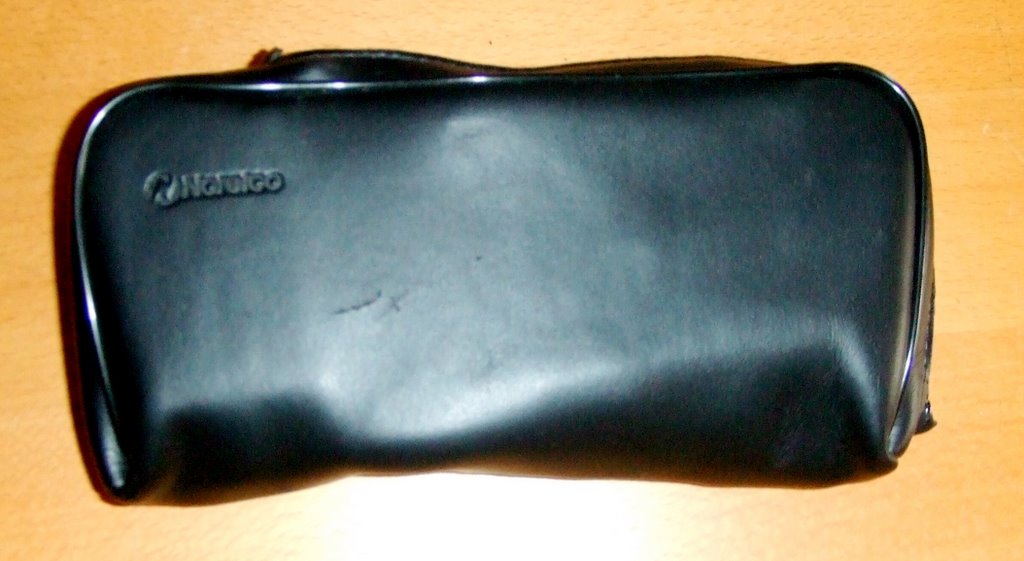
The items in the kit fit, more or less neatly, in a small bag:


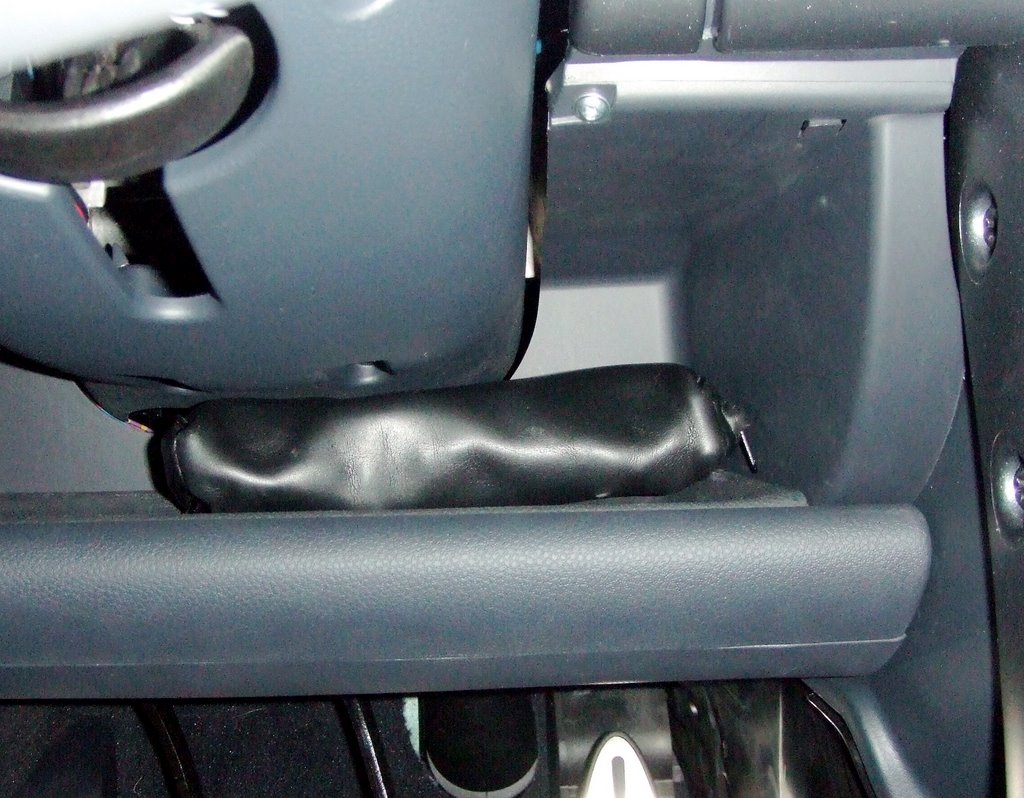
which in turn nestles happily in my newly installed euro parcel tray:


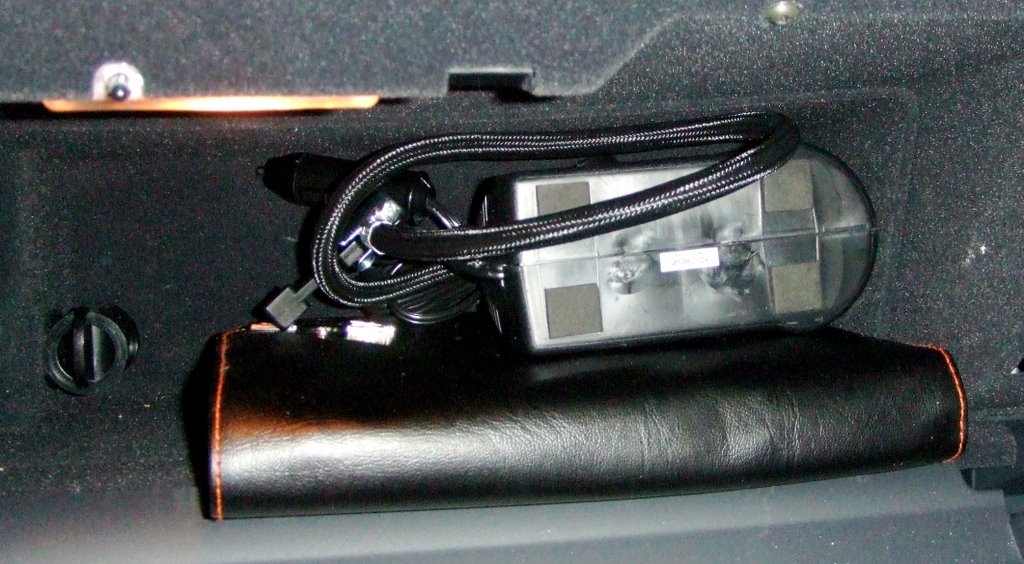
I also purchased the smallest tire pump that I could find, which fits easily in the glove compartment:


I'm going to live with the run-flat tires for a while, but I expect to ultimately replace them with regular tires with better performance characteristics.

Friday, June 30, 2006

The Banzai Pipeline?

The traffic reporter on Channel 4, in a passing remark this morning, said that the State Police refer to route 128 (aka I-95) as the "Banzai Pipeline". This term certainly captures the essence of driving on 128, and if true, it also provides a clue as to (a) why you never see anyone pulled over on 128 and (b) what the likely limits of acceptable driving speed and behavior are, at least in the eye of the law.

Cowabunga!